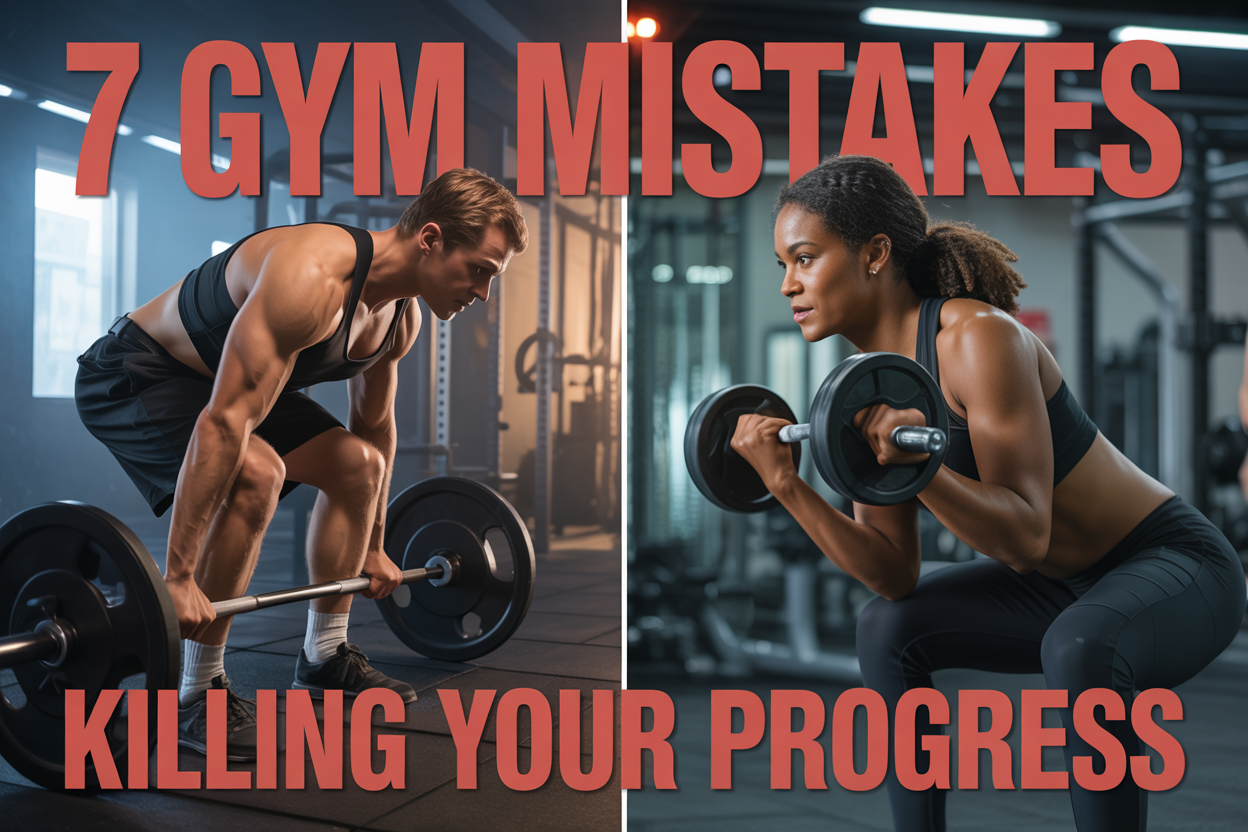
You’re hitting the gym regularly, eating better, and staying committed to your fitness goals. But after months of hard work, the scale won’t budge, your strength has plateaued, and you’re feeling more frustrated than motivated.
If you’re a beginner or intermediate gym-goer who feels stuck despite your best efforts, you might be making common gym mistakes that are quietly sabotaging your progress. These errors are sneaky – they don’t feel wrong in the moment, but they add up to wasted time and disappointing results.
We’ll break down the seven biggest mistakes that keep people spinning their wheels at the gym. You’ll learn why skipping your warm-up is setting you up for injury and poor performance, how choosing the wrong workout program can actually move you further from your goals, and why your form matters more than the weight on the bar. Most importantly, you’ll get practical fixes you can start using today to finally see the progress you’ve been working so hard for.
Skipping Your Warm-Up and Cool-Down Routines

How Cold Muscles Increase Injury Risk and Reduce Performance
Walking straight into heavy lifting with cold muscles is like trying to stretch a rubber band that’s been sitting in the freezer. Your muscles need time to warm up and become pliable before they can handle the stress of intense exercise. When your muscles are cold, they’re tight, stiff, and less responsive to neural commands from your brain.
Cold muscles have reduced blood flow, which means less oxygen and nutrients reaching the muscle fibers. This creates a perfect storm for injury – your muscles can’t contract as efficiently, your joints have limited range of motion, and your coordination suffers. Studies show that muscle temperature needs to increase by just 2-3 degrees Celsius to significantly improve power output and reduce injury risk.
The most common injuries from skipping warm-ups include muscle strains, joint sprains, and tendon pulls. Your connective tissues become brittle when cold, making them more likely to tear under sudden stress. Even if you don’t get injured immediately, cold muscles fatigue faster and generate less force, meaning you’re leaving gains on the table every single workout.
Simple 5-Minute Warm-Up Sequences That Boost Workout Effectiveness
A proper warm-up doesn’t require complicated equipment or endless time. Here’s a dynamic sequence that preps your entire body in just five minutes:
Minutes 1-2: General Movement
- 30 seconds of light jogging in place or marching
- 30 seconds of arm circles (forward and backward)
- 30 seconds of leg swings (front-to-back, then side-to-side)
- 30 seconds of torso twists
Minutes 3-4: Dynamic Stretching
- Walking lunges with rotation (8-10 reps each leg)
- High knees (30 seconds)
- Butt kicks (30 seconds)
- Inchworms (5-6 reps)
Minute 5: Movement Rehearsal
- Bodyweight squats (10-15 reps)
- Push-up to downward dog (5-8 reps)
- Glute bridges (10-12 reps)
This sequence gradually increases your heart rate, lubricates your joints, and activates the muscle groups you’re about to train. Your body temperature rises, blood flow increases, and your nervous system gets primed for action.
Cool-Down Strategies That Accelerate Recovery and Prevent Soreness
Your workout doesn’t end when you rack the weights. A proper cool-down helps your body transition from high-intensity exercise back to rest mode. This transition period is when your body starts the recovery process that builds strength and muscle.
Immediate Post-Workout (5-10 minutes):
Start with 3-5 minutes of light walking or easy movement to gradually lower your heart rate. This prevents blood from pooling in your extremities and helps flush metabolic waste from your muscles.
Static Stretching Protocol:
Hold each stretch for 30-60 seconds, focusing on the muscles you just trained:
- Chest doorway stretch
- Standing quad stretch
- Standing hamstring stretch
- Seated spinal twist
- Child’s pose
Advanced Recovery Techniques:
- Foam rolling major muscle groups (2-3 minutes total)
- Deep breathing exercises (4-7-8 pattern)
- Gentle yoga poses like cat-cow or pigeon pose
The cool-down period helps reduce muscle tension, improves flexibility, and kickstarts the parasympathetic nervous system responsible for recovery. People who consistently cool down report less next-day soreness and feel more prepared for their following workout. Your muscles need this gradual transition to begin rebuilding stronger than before.
Following the Wrong Workout Program for Your Goals

Why Copying Someone Else’s Routine Sabotages Your Progress
Grabbing that shredded influencer’s workout plan might seem like a shortcut to success, but you’re actually setting yourself up for failure. Every person walks into the gym with different experience levels, body types, injury histories, and available time. What works for someone who’s been training for five years and can dedicate two hours daily won’t translate to your 45-minute lunch break sessions.
Your body responds to stress differently than anyone else’s. That advanced powerlifting routine your gym buddy swears by could leave you overtrained and burned out within weeks if you’re a beginner. Meanwhile, copying a bodybuilder’s high-volume split when you’re trying to lose weight might leave you spinning your wheels instead of seeing the fat loss results you want.
The biggest trap? Social media fitness personalities often don’t share their complete picture. You see the glamorous workout clips, but you don’t see their years of building up to that intensity, their recovery protocols, or the fact that training is literally their full-time job.
Matching Exercise Selection to Fat Loss Versus Muscle Building Goals
Your exercise choices should align directly with what you’re trying to achieve. Fat loss and muscle building require different approaches, and mixing them up wastes precious gym time.
For Fat Loss:
- Prioritize compound movements that burn more calories
- Include metabolic circuits and supersets
- Add cardio intervals between strength exercises
- Focus on higher repetition ranges (12-20 reps)
- Incorporate full-body workouts 3-4 times per week
For Muscle Building:
- Emphasize progressive overload with heavier weights
- Use moderate rep ranges (6-12 reps)
- Allow longer rest periods between sets (2-3 minutes)
- Target specific muscle groups with isolation exercises
- Follow structured split routines for adequate recovery
Many people make the mistake of trying to chase both goals simultaneously with the same routine. While beginners can build muscle and lose fat together, most people need to pick a primary focus for 8-12 weeks to see significant results.
Progressive Overload Principles That Guarantee Consistent Gains
Progressive overload is the non-negotiable foundation of any successful workout program. Your muscles adapt to stress quickly, so you must consistently challenge them in new ways to keep growing stronger.
The Four Ways to Apply Progressive Overload:
| Method | How to Apply | Example |
|---|---|---|
| Weight | Add 2.5-5 lbs when you can complete all sets with perfect form | Bench press: 135 lbs → 140 lbs |
| Reps | Increase repetitions within your target range | 3 sets of 8 → 3 sets of 10 |
| Sets | Add an additional set to your exercise | 3 sets → 4 sets |
| Time | Manipulate rest periods or tempo | 60-second rest → 45-second rest |
Track your lifts religiously. If you’re not getting stronger over time, you’re not applying enough progressive stress. Start conservatively – adding just 2.5 pounds per week adds up to 130 pounds over a year. Small, consistent increases beat sporadic jumps that lead to form breakdown and plateaus.
How to Identify if Your Current Program Isn’t Working
Your body gives clear signals when your program needs an overhaul. Stop ignoring these red flags and make the necessary changes.
Warning Signs Your Program Is Failing:
- No strength gains for 3-4 weeks straight
- Feeling exhausted before workouts even begin
- Losing motivation to hit the gym consistently
- Experiencing frequent minor injuries or joint pain
- Not seeing visual changes after 6-8 weeks of consistent training
Performance Metrics to Track:
- Strength progression on key lifts (squat, deadlift, bench, overhead press)
- Body measurements and progress photos
- Energy levels throughout the day
- Sleep quality and recovery time between sessions
- Workout completion rate and consistency
If you’re checking multiple boxes in the warning signs category, it’s time for a program change. Don’t fall into the trap of thinking you need to push through – sometimes stepping back and reassessing saves months of wasted effort. A good program should leave you feeling challenged but not destroyed, progressing but not burned out.
Using Poor Form and Technique

Common form mistakes that waste your time and effort
Poor form creeps into workouts more often than most people realize. One of the biggest culprits is using momentum instead of muscle control. You’ll see this everywhere in gyms – people swinging dumbbells during bicep curls, bouncing the bar off their chest during bench press, or using their back to throw weights up during shoulder raises. When you rely on momentum, you’re essentially cheating yourself out of the muscle engagement you came to the gym for.
Another major mistake is partial range of motion. Many lifters load up the bar with more weight than they can handle through a full movement, then perform half-reps that barely challenge their muscles. Quarter squats might stroke your ego, but they won’t build the leg strength that full-depth squats deliver.
Improper breathing patterns also sabotage your efforts. Holding your breath during entire sets or breathing at the wrong times reduces oxygen to your muscles and limits your performance. The basic rule is simple: exhale during the exertion phase and inhale during the lowering phase.
Poor posture and alignment waste energy and reduce effectiveness. Rounded shoulders during back exercises, arched backs during overhead presses, or forward head posture during most movements all compromise your ability to target the intended muscles properly.
How improper technique limits muscle activation and growth
When your form breaks down, you’re not just risking injury – you’re dramatically reducing the effectiveness of every rep. Proper form ensures that the target muscles do the majority of the work, while poor form allows other muscles to compensate and take over.
Take the lat pulldown as an example. When performed correctly with a slight lean back, chest up, and pulling to the upper chest, your lats get maximum activation. But when people pull behind their neck, round their shoulders, or use excessive momentum, the movement becomes a collaborative effort between multiple muscle groups, with the lats getting minimal stimulation.
The same principle applies to compound movements like squats and deadlifts. Poor hip hinge mechanics during deadlifts can shift the load from your glutes and hamstrings to your lower back, not only reducing the training effect on your posterior chain but also creating injury risk.
Muscle activation studies consistently show that proper form can increase target muscle engagement by 30-50% compared to sloppy technique. This means you could potentially get better results from lifting lighter weights with perfect form than heavier weights with compromised technique.
Time under tension also gets compromised with poor form. When you use momentum or bounce out of the bottom position, you’re reducing the actual work your muscles perform, limiting the stimulus for growth and strength gains.
Warning signs your form is breaking down during exercises
Your body gives you clear signals when technique starts to deteriorate, but you need to know what to look for. Muscle cramping or unusual fatigue in muscles that shouldn’t be working hard during a particular exercise is a red flag. If your lower back is burning during bicep curls or your shoulders are taking over during tricep exercises, your form has gone sideways.
Watch for compensation patterns developing mid-set. When you start tilting to one side during squats, your torso begins leaning forward excessively during overhead presses, or your knees cave inward during lunges, these are clear signs that fatigue is compromising your movement quality.
Pain or discomfort in joints rather than muscles is another warning sign. While muscle fatigue and the burning sensation are normal, sharp pains, pinching sensations, or joint discomfort usually indicate poor alignment or technique issues.
Your breathing pattern can also reveal form breakdown. If you find yourself holding your breath for extended periods or breathing becomes labored earlier than usual, your body might be working harder to stabilize poor positioning.
Mental focus is equally important to monitor. When you can’t feel the target muscle working or you lose the mind-muscle connection, it’s often because other muscles have taken over due to form deterioration. This is your cue to reduce the weight, reset your position, or take a longer rest between sets.
Not Tracking Your Workouts and Progress

Why guessing your weights and reps kills momentum
Walking into the gym without knowing what you lifted last week is like showing up to a job interview without knowing what company you’re applying to. You’re basically flying blind. When you’re constantly guessing whether you used 135 or 145 pounds for your bench press, or whether you did 8 or 10 reps last time, you rob yourself of the ability to progressively overload your muscles.
Progressive overload is the golden rule of muscle building and strength gains. Your body adapts to whatever stress you place on it, so you need to gradually increase that stress over time. Without tracking, you might accidentally use lighter weights than last week, thinking you’re pushing harder when you’re actually going backward. This creates a frustrating cycle where you feel like you’re working hard but seeing minimal results.
Your muscles need consistent, measurable challenges to grow. When you guess your way through workouts, you miss opportunities to add that extra 5 pounds or squeeze out one more rep that would signal your body to adapt and get stronger.
Simple tracking methods that take less than 2 minutes per workout
You don’t need a complicated system to track your workouts effectively. The simplest approach is carrying a small notebook and pen to the gym. Write down the exercise name, weight used, sets, and reps completed. That’s it. Takes maybe 30 seconds between sets.
If you prefer digital options, smartphone apps like Strong, Jefit, or even a basic notes app work perfectly. These apps often have pre-loaded exercise databases and can calculate your one-rep max automatically. Some people swear by simple spreadsheets on their phone – create columns for date, exercise, weight, sets, and reps.
The key is consistency, not complexity. Pick one method and stick with it for at least a month. Many people overthink this and end up tracking nothing because they’re waiting for the “perfect” system. A basic notebook beats the most sophisticated app if you actually use it.
Key metrics to monitor beyond just weight on the scale
Body weight is just one piece of the puzzle and often the most misleading one. Your weight can fluctuate 2-5 pounds daily based on water retention, food timing, and hormonal changes. Focus on these more reliable indicators instead:
Strength metrics tell the real story of your progress. Track your personal records for major lifts like squats, deadlifts, bench press, and rows. Even small increases – adding 5 pounds to your squat or getting one extra rep at the same weight – indicate muscle growth and improved conditioning.
Body measurements provide concrete evidence of changes happening in your physique. Measure your chest, waist, hips, arms, and thighs monthly. You might gain muscle while losing fat, which won’t show on the scale but will be obvious in your measurements.
Performance markers like how many push-ups you can do, how long you can plank, or your mile run time reflect improvements in muscular endurance and cardiovascular fitness.
Energy levels and recovery matter too. Note how you feel during workouts, your sleep quality, and how sore you are between sessions. These subjective measures help you understand if you’re overtraining or recovering well.
How to adjust your program based on your tracking data
Your tracking data becomes your roadmap for making smart program adjustments. When you see consistent strength gains over 4-6 weeks, that’s your green light to increase training volume or intensity. Add more weight, extra sets, or additional exercises targeting the same muscle groups.
If your numbers plateau for 2-3 weeks, don’t panic – this is normal. First, check your recovery factors: are you sleeping enough, eating adequately, and managing stress? Sometimes a plateau just means you need a deload week with lighter weights to let your body catch up.
When certain exercises consistently stall while others progress, that exercise might not be right for your body type or current fitness level. Your tracking data will reveal these patterns clearly. Maybe your overhead press hasn’t budged in a month, but your incline dumbbell press keeps improving – that’s valuable information.
Use your energy and recovery notes to adjust workout frequency. If you’re consistently feeling drained or seeing declining performance, you might need more rest days or easier weeks. Conversely, if you’re recovering quickly and feeling energetic, you might be ready to add another training session per week.
The data also helps you identify which rep ranges work best for you. Some people respond better to heavy weights and low reps, while others thrive with moderate weights and higher reps. Your tracking will reveal your sweet spot over time.
Ignoring Recovery and Rest Days

Why more gym time doesn’t equal faster results
Your muscles don’t actually grow in the gym – they grow when you’re sleeping on your couch. During workouts, you create microscopic tears in muscle fibers. The real magic happens during recovery when your body repairs these tears, making them stronger and bigger than before. Without adequate rest, you’re essentially breaking down muscle faster than your body can rebuild it.
Think of your body like a construction site. You wouldn’t expect workers to build a skyscraper without breaks, materials, or time to let the concrete set. Your muscles need the same consideration. Training seven days a week might make you feel productive, but you’re actually sabotaging your own progress.
The stress hormone cortisol shoots up when you overtrain, which blocks muscle growth and promotes fat storage around your midsection. Your central nervous system also needs time to recover from intense training sessions. Push too hard without rest, and you’ll find your performance declining, your motivation tanking, and your injury risk skyrocketing.
Sleep requirements for optimal muscle growth and fat loss
Sleep isn’t just about feeling rested – it’s your body’s prime time for releasing growth hormone, which drives muscle repair and fat burning. Adults need 7-9 hours of quality sleep per night for optimal results, but most gym-goers are getting by on 5-6 hours and wondering why their progress stalled.
During deep sleep phases, your body releases up to 75% of its daily growth hormone. This powerful hormone doesn’t just build muscle; it also breaks down fat cells for energy. Skimp on sleep, and you’re cutting off this natural performance enhancer at the source.
Poor sleep also wreaks havoc on hunger hormones. Ghrelin (the hunger hormone) increases while leptin (the satiety hormone) decreases, making you crave high-calorie junk food. You’ve probably experienced this after a bad night’s sleep – suddenly that donut looks irresistible.
| Sleep Duration | Growth Hormone Release | Recovery Quality | Next-Day Performance |
|---|---|---|---|
| 5-6 hours | 40% reduction | Poor | Decreased strength |
| 7-8 hours | Optimal levels | Good | Maintained |
| 9+ hours | Peak levels | Excellent | Enhanced |
Active recovery techniques that speed up your progress
Rest days don’t mean becoming a couch potato. Active recovery keeps blood flowing to your muscles, delivering nutrients and removing waste products that cause soreness. Light movement on off days actually speeds up recovery compared to complete inactivity.
Try these active recovery methods:
- Light walking or hiking: 20-30 minutes at a conversational pace
- Gentle yoga or stretching: Focus on tight areas from your workouts
- Swimming or water walking: The hydrostatic pressure reduces inflammation
- Foam rolling: Spend 10-15 minutes on major muscle groups
- Bike rides: Easy pace, enjoy the scenery
The key is keeping your heart rate in the 50-60% range of your max heart rate. You should feel energized, not exhausted, after active recovery sessions. If you’re sweating heavily or breathing hard, you’re working too intensely.
Mobility work on rest days pays huge dividends. Tight hips, shoulders, and ankles limit your range of motion in key exercises, reducing muscle activation and increasing injury risk. Spending 15 minutes addressing these issues will improve your squat depth, bench press stability, and deadlift form.
Rushing Through Workouts Without Focus

How distractions and multitasking reduce exercise effectiveness
Your phone buzzes with a text mid-set. You glance at the TV screen while doing squats. Sound familiar? These tiny interruptions pack a bigger punch to your workout than you realize. When your attention splits between multiple tasks, your nervous system can’t fully activate the muscles you’re trying to train.
Research shows that distracted training leads to reduced muscle activation by up to 30%. Your brain essentially puts your muscles on autopilot, which means less strength gains and slower progress. The quality of each rep drops dramatically when you’re not mentally present. You might complete your sets, but you’re leaving serious gains on the table.
Checking your phone between sets isn’t just a time-waster—it keeps your nervous system from properly recovering and preparing for the next set. Social media scrolling triggers stress responses that interfere with your body’s natural training adaptations.
Mind-muscle connection techniques that maximize every rep
Think of the mind-muscle connection as your internal GPS for better workouts. Before each set, spend 10-15 seconds visualizing the target muscle working. For chest exercises, imagine your pecs contracting and stretching. This mental rehearsal primes your nervous system for optimal muscle recruitment.
Try these practical techniques:
- Pre-activation touches: Lightly tap the muscle you’re about to train before starting your set
- Slow eccentrics: Control the lowering portion of each rep for 3-4 seconds while focusing on the stretch
- Pause reps: Hold the contracted position for 1-2 seconds at the top of each movement
- Internal cuing: Think “squeeze the muscle” rather than “move the weight”
Start with lighter weights when practicing these techniques. You’ll be surprised how much harder exercises feel when you’re truly connected to the movement. A focused set with 80% of your max often produces better results than a distracted set at 100%.
Time management strategies for quality over quantity workouts
Shorter, focused workouts beat long, scattered sessions every time. A well-structured 45-minute workout with full attention delivers more progress than a two-hour gym marathon filled with distractions.
Plan your workout before arriving at the gym. Write down exercises, sets, and reps on your phone or a notebook. This eliminates decision fatigue and keeps you moving with purpose. Set specific rest periods—usually 60-90 seconds for hypertrophy work and 3-5 minutes for strength training.
| Workout Duration | Focus Level | Typical Results |
|---|---|---|
| 30-45 minutes | High | Excellent progress |
| 60-75 minutes | Moderate | Good progress |
| 90+ minutes | Low | Diminishing returns |
Use compound movements as your foundation. Exercises like squats, deadlifts, and pull-ups work multiple muscle groups efficiently. Save isolation exercises for the end when you have extra time and energy.
Creating the right mindset for productive training sessions
Your mindset walking into the gym determines your workout quality before you touch a single weight. Treat each training session like an important business meeting—show up prepared and ready to work.
Create a pre-workout ritual that signals your brain it’s time to focus. This might include listening to specific music, doing breathing exercises, or reviewing your workout plan. Elite athletes use these mental switches to enter a focused state quickly.
Leave your phone in your locker or car when possible. If you need it for music or tracking, put it in airplane mode and use only essential apps. The constant ping of notifications pulls your attention away from the task at hand.
Set small, specific goals for each workout. Instead of “train hard today,” try “add 5 pounds to my bench press” or “complete all sets without resting longer than planned.” These micro-goals keep your mind engaged and create momentum for long-term progress.
Remember that training is a skill. Just like learning to play piano or drive a car, focused practice makes you better. Each distracted workout is a missed opportunity to improve this skill and move closer to your goals.
Neglecting Nutrition and Hydration Basics

How poor eating habits undermine hours of gym work
Your workout might be perfect, but if your nutrition is off track, you’re basically spinning your wheels. Poor eating habits can completely cancel out even the most intense gym sessions. When you fuel your body with processed junk, refined sugars, and empty calories, you’re not giving your muscles the building blocks they need to repair and grow.
Think about it this way: you wouldn’t put regular gas in a Ferrari and expect peak performance. Your body works the same way. Without proper protein intake, your muscles can’t rebuild stronger after your workouts. Skip essential fats, and your hormone production suffers, affecting everything from testosterone to recovery hormones. Load up on excessive processed foods, and inflammation increases, slowing down your recovery and making your next workout feel harder than it should.
The timing matters just as much as the quality. Eating a massive meal right before training leaves you sluggish and uncomfortable. Going to the gym completely fasted might leave you weak and unable to push through challenging sets. Many people also underestimate their caloric needs when trying to build muscle or overestimate their burn when trying to lose fat, creating a mismatch between their goals and their plate.
Pre and post-workout nutrition timing for better results
Getting your nutrition timing right can make the difference between mediocre results and real progress. Your body has specific windows where it’s primed to use nutrients most effectively, especially around your workouts.
Pre-workout nutrition (1-3 hours before):
- Eat a balanced meal with carbs for energy and protein for muscle support
- Good options: oatmeal with berries and Greek yogurt, or a turkey and sweet potato wrap
- Avoid high-fat or high-fiber foods that can cause digestive issues
Pre-workout snack (30-60 minutes before):
- Keep it light and easily digestible
- Focus on simple carbs for quick energy
- Examples: banana with a small amount of almond butter, or a piece of toast with honey
Post-workout nutrition (within 30-60 minutes):
- Your muscles are like sponges, ready to absorb nutrients
- Combine protein (20-30 grams) with carbs to kickstart recovery
- Chocolate milk, protein shake with fruit, or Greek yogurt with granola all work well
Post-workout meal (within 2 hours):
- This is where you can eat a full, balanced meal
- Include lean protein, complex carbs, and vegetables
- Think grilled chicken with quinoa and roasted vegetables
The key is consistency. Your body adapts to patterns, so try to eat around the same times relative to your workouts.
Hydration strategies that improve performance and recovery
Water isn’t just about quenching thirst – it’s actually one of the most powerful performance enhancers available. Even mild dehydration (losing just 2% of your body weight in water) can reduce your strength, power, and endurance significantly.
Daily hydration baseline:
- Aim for half your body weight in ounces of water per day
- Add 16-24 ounces for every hour of intense exercise
- Check your urine color – pale yellow means you’re on track
Pre-workout hydration:
- Drink 16-20 ounces of water 2-3 hours before exercising
- Have another 8 ounces 15-20 minutes before you start
- Don’t chug water right before lifting – you’ll feel uncomfortable
During workout hydration:
- For workouts under an hour, water is usually enough
- For longer sessions or intense sweating, consider electrolyte replacement
- Sip regularly rather than waiting until you feel thirsty
Post-workout hydration:
- Weigh yourself before and after workouts
- Drink 150% of the weight you lost (if you lost 1 pound, drink 24 ounces)
- Include some sodium to help retain the water you’re drinking
Temperature matters too. Room temperature or slightly cool water gets absorbed faster than ice-cold water, which can sometimes cause cramping during intense exercise.
Common supplement mistakes that waste your money
The supplement industry loves to prey on people looking for shortcuts, and gyms are full of people throwing money at pills and powders that don’t deliver. Here are the biggest money-wasters and what actually works.
Biggest supplement mistakes:
- Buying proprietary blends – you can’t see individual ingredient amounts, so you’re gambling blind
- Chasing the latest trends – that new “fat-burning” supplement probably doesn’t work any better than caffeine
- Ignoring basics for fancy stuff – getting exotic mushroom extracts while your protein intake is inadequate
- Not researching dosages – many supplements use “fairy dust” amounts that look good on labels but won’t do anything
What actually works:
- Protein powder – convenient way to hit your daily protein targets
- Creatine monohydrate – proven strength and power booster, costs about $10 for months of supply
- Vitamin D – most people are deficient, especially if you train indoors
- Magnesium – helps with sleep and muscle recovery
- Caffeine – reliable energy booster, much cheaper than pre-workout mixes
Smart supplement shopping:
- Read actual research, not marketing claims
- Buy single-ingredient supplements instead of complex mixes
- Generic brands often contain identical ingredients at half the cost
- Focus on filling gaps in your diet, not replacing good nutrition
Remember, supplements are meant to supplement a good diet and training program, not replace them.
Simple meal planning approaches that support your fitness goals
Meal planning doesn’t have to be complicated spreadsheets and weighing every gram of food. Simple, consistent approaches work best for most people and actually get followed long-term.
The plate method:
- Fill half your plate with vegetables
- One quarter with lean protein (size of your palm)
- One quarter with complex carbs (size of your fist)
- Add a thumb-sized portion of healthy fats
Batch cooking strategies:
- Cook proteins in bulk on Sundays (grilled chicken, lean ground turkey, hard-boiled eggs)
- Prep versatile carbs (brown rice, quinoa, sweet potatoes)
- Wash and chop vegetables for the week
- Make overnight oats or chia puddings for easy breakfasts
Goal-specific adjustments:
- Building muscle: Add an extra palm-sized serving of protein and increase overall portions
- Losing fat: Keep protein high, reduce carb portions slightly, load up on vegetables
- Maintaining weight: Stick to the basic plate method and listen to hunger cues
Emergency meal ideas:
- Greek yogurt with nuts and berries
- Protein smoothie with spinach and fruit
- Canned tuna with avocado on whole grain bread
- Eggs scrambled with whatever vegetables you have
The best meal plan is one you can stick to consistently. Start simple, build habits, and add complexity only when needed. Perfection isn’t the goal – consistency is.

Breaking bad gym habits can completely transform your fitness journey. Skipping warm-ups and cool-downs sets you up for injuries, while poor form wastes your time and puts you at risk. When you’re not tracking your progress or following a program that matches your goals, you’re basically working out blindly. Add in rushed workouts, ignored recovery days, and poor nutrition choices, and you’ve got a recipe for frustration and plateaus.
The good news is that fixing these mistakes doesn’t require a complete overhaul of your routine. Start with one or two changes – maybe begin tracking your workouts this week or focus on perfecting your form for just a few exercises. Your body will thank you, your results will improve, and you’ll actually start enjoying your gym sessions again. Remember, consistency with good habits beats intensity with bad ones every single time.

Saurabh Kumar is the founder of SaurabhOrbit.com, a hub for tech news, digital marketing insights, and expert blogging advice. With a deep passion for technology and digital strategies, Saurabh simplifies complex trends into actionable insights for readers looking to stay ahead in the digital world. My mission is to empower entrepreneurs, tech enthusiasts, and marketers with the latest tools and knowledge to thrive in the online space.